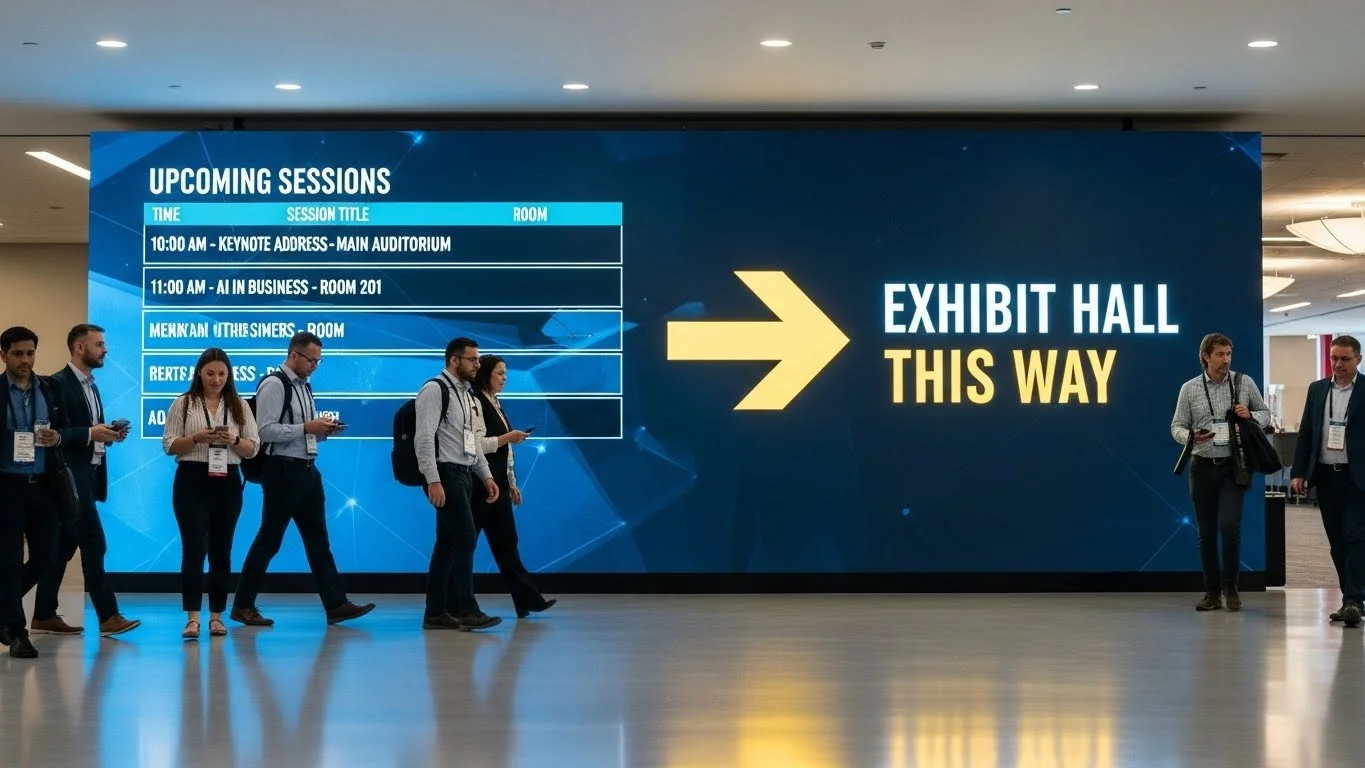
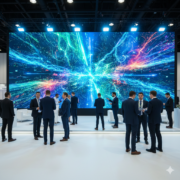
Large conferences in Orlando present a unique operational challenge. Multiple halls, overlapping sessions, and thousands of attendees make navigation difficult. Static signage cannot adapt once doors open, leading to confusion and missed sessions.
Event teams are increasingly using LED walls as operational tools to guide attendees, update schedules in real time, and improve overall event flow.
https://www.avrexpos.com/wp-content/uploads/2026/01/Event-Wayfinding-Orlando.webp7681365Nicholas Baadshaughttps://www.avrexpos.com/wp-content/uploads/2023/08/AVR-logo-1.webpNicholas Baadshaug2026-01-03 16:58:582026-01-05 22:12:24How Orlando Event Teams Use LED Walls to Improve Attendee Flow and Navigation
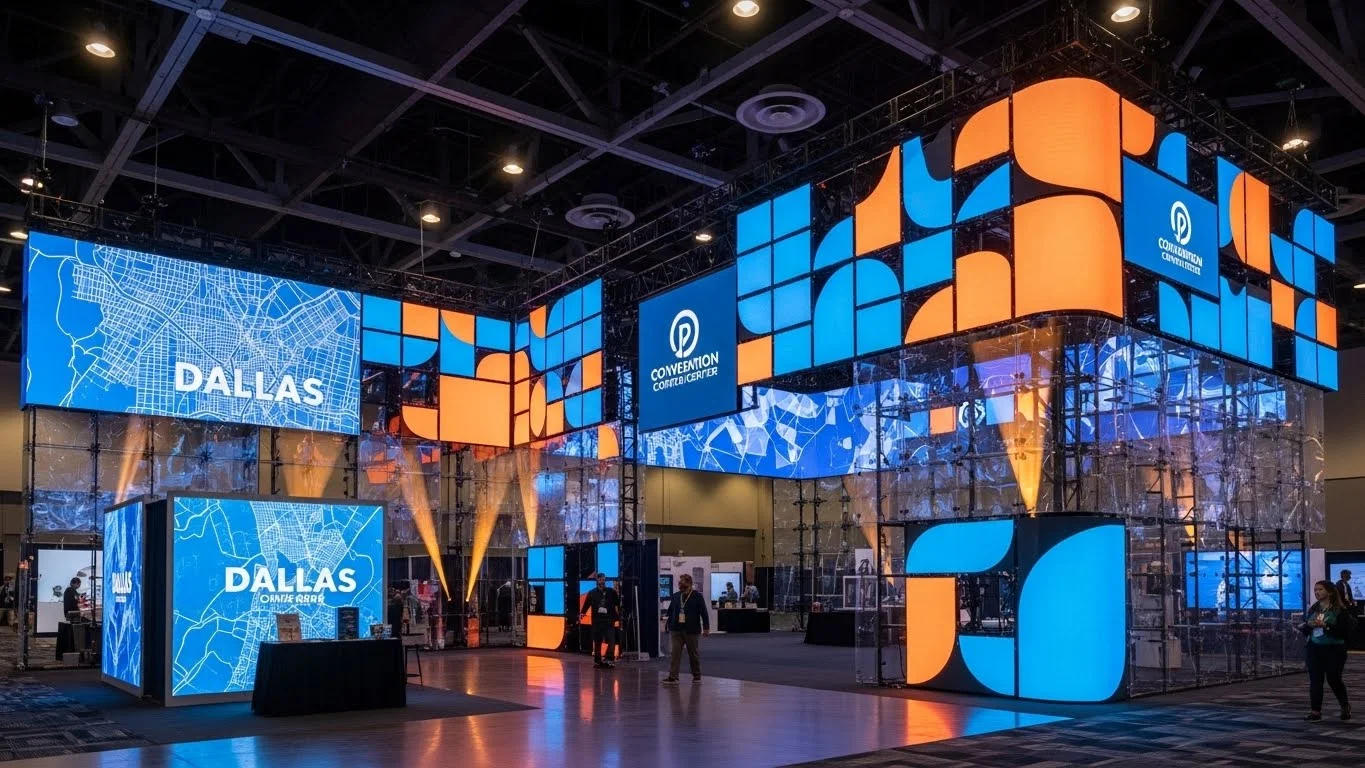
Trade shows in Dallas are defined by scale and constant change. Booth sizes vary, layouts shift, and venue rules evolve from show to show. Static backwalls and printed graphics often fail to keep pace, locking exhibitors into designs that no longer fit their strategy.
Modular LED wall designs allow exhibitors to resize and reconfigure displays without sacrificing visual impact or brand consistency.
Modular LED walls are built from individual tiles, allowing precise control over size and aspect ratio. The same system can be used for a 10×20 booth at one show and expanded for a larger footprint at the next.
Why Static Displays Struggle in Dallas
Dallas venues frequently change booth orientation, height limits, and fire-marshal requirements. Printed displays require reprints and storage. LED walls adapt without additional production costs or delays.
Events in Washington DC operate under stricter expectations than most major markets. Government briefings, policy conferences, and association events require precision, neutrality, and the ability to respond to last-minute content changes. Printed signage and traditional projection systems struggle in this environment, where messaging accuracy is critical and updates often happen hours before doors open.
LED walls have become a preferred solution for DC event planners who need flexibility without risk. They allow teams to maintain control over messaging, ensure visual consistency, and present information clearly in compliance-driven environments.
Policy-focused events often involve multiple stakeholders, legal review, and layered approvals. A single outdated slide or incorrect title can undermine credibility. LED walls allow planners to make immediate content changes without reprinting materials or disrupting the event flow.
How LED Walls Support Compliance-Driven Environments
Real-Time Content Updates
Speaker titles, disclaimers, schedules, and approved language can be updated onsite. LED walls eliminate the risk of displaying outdated or unapproved information.
Consistent Messaging Across Rooms
Centralized LED displays ensure that branding and language remain uniform across plenary sessions, breakout rooms, and press briefings.
Projection systems are sensitive to lighting, alignment, and room conditions. LED walls provide consistent brightness, eliminate shadows, and maintain visibility in brightly lit venues commonly used for federal and association events.
Where LED Walls Are Most Effective
Main session backdrops
Press briefing rooms
Registration and wayfinding areas
Sponsor recognition zone
Washington DC event AV support
Planning a government or policy event in Washington DC? AVR Expos designs LED wall solutions built for compliance-focused environments where accuracy and control matter.
https://www.avrexpos.com/wp-content/uploads/2026/01/Washington-DC-Event-Planners.webp7681365Nicholas Baadshaughttps://www.avrexpos.com/wp-content/uploads/2023/08/AVR-logo-1.webpNicholas Baadshaug2026-01-01 17:54:212026-01-07 13:51:32How Washington DC Event Planners Use LED Walls to Maintain Message Control
A trade show presentation zone is one of the most effective ways to drive engagement, demonstrate expertise, and convert foot traffic into qualified leads. Yet most exhibitors overlook it entirely. They rely on passive displays rather than crafting a space built for storytelling, product demos, or speaker-led mini-sessions. A well-designed presentation zone transforms a booth from a static display into a dynamic experience.
Whether you’re working with a 10×10, a 10×20, or a large island booth, the principles are the same: visibility, clarity, flow, and comfort. This guide breaks down exactly how to build a presentation zone that pulls attendees in and keeps them engaged.
Identify the Purpose of Your Presentation Zone
A presentation zone can serve multiple functions:
Product education
Expert talks
Customer testimonials
Training modules
Software walk-throughs
Define the core purpose before designing anything.
Choose the Right Display Type
Option 1: Large Monitor
A 75–98 inch display is ideal for smaller booths.
Option 2: LED Wall
Best for high-impact visuals and larger crowds.
Option 3: Touchscreen
Allows interactive demos and audience participation.
Plan Seating and Standing Areas
For small booths:
Use standing zones
Eliminate chairs to reduce clutter
For larger booths:
Bar stools
Benches
Modular seating
Keep sightlines clear.
Audio Strategy for Presentation Zones
Use directional speakers
These reduce noise spill into aisles.
Choose the right microphone
Handheld for Q&A
Headset for mobile presenters
Lavalier for multi-step demos
Mixing and control
Use a small digital mixer for flexibility.
Lighting Considerations
Use:
Soft white LED lighting
Spotlights on presenters
Accent lighting around the display
Avoid harsh overhead light that washes out visuals.
Content Structure
Short, punchy segments work best:
2–3 minute intros
5–8 minute demos
2 minute Q&A
Long presentations lose foot traffic.
Use Signage to Promote Your Presentation Schedule
Add:
Vertical screens with schedule loops
QR codes for reminders
Digital timers for countdown
FAQs
Q1: How many presentations should I run per hour?
One every 20–30 minutes keeps your booth active without overwhelming staff.
Q2: Does a presentation zone require extra AV?
Often just a display, mic, and small mixer — cost-efficient and high-impact.
Q3: Can AVR Expos build my entire presentation zone?
Yes, including monitors, LED walls, audio, lighting, and tech support.
https://www.avrexpos.com/wp-content/uploads/2025/12/Gemini_Generated_Image_7xomk37xomk37xom.png10241024Nicholas Baadshaughttps://www.avrexpos.com/wp-content/uploads/2023/08/AVR-logo-1.webpNicholas Baadshaug2025-12-14 09:44:282026-01-02 20:26:37How to Build a High-Impact Presentation Zone Inside Any Trade Show Booth
Product demos are the heartbeat of most trade show booths. They convince attendees, differentiate brands, and communicate value faster than anything else. But exhibitors today are split between two dominant demo strategies: digital and physical. Some rely heavily on technology-driven experiences, while others showcase real products on tables or stands. The truth is, neither approach is universally better — but each carries specific strengths, limitations, and ideal use cases.
This blog breaks down the differences between digital and physical demos, explains when each works best, and shows how exhibitors can combine both for maximum impact.
Is the product complex or multi-layered? Use both.
FAQs
Q1: Which type of demo attracts more people?
Digital demos attract from the aisle; physical demos convert interest into trust.
Q2: Are digital demos expensive to build?
Not with prebuilt templates and existing content assets.
Q3: Can AVR Expos support hybrid demo setups?
Yes — we provide touchscreens, LED walls, monitors, and full booth AV integration.
https://www.avrexpos.com/wp-content/uploads/2025/12/Gemini_Generated_Image_4w40np4w40np4w40.png7681408Nicholas Baadshaughttps://www.avrexpos.com/wp-content/uploads/2023/08/AVR-logo-1.webpNicholas Baadshaug2025-12-10 06:34:432026-01-13 17:32:56Digital vs. Physical Product Demos: Which Works Better at Trade Shows?
Trade show budgets get eaten alive by logistics, freight, labor, and booth construction long before AV even enters the conversation. Yet AV is the one category exhibitors consistently overspend on — not because good AV is expensive, but because poor planning creates waste. You don’t have to cut quality to cut costs. The smartest exhibitors reduce their AV bill by making informed decisions, eliminating unnecessary rentals, and optimizing for what actually affects attendee engagement.
This guide breaks down where trade show AV dollars get wasted and how to redirect your budget toward equipment and services that produce results. Whether you’re working with LED walls, monitors, projectors, audio, or interactive displays, these principles will help you control costs while maintaining a polished, professional booth.
Start With the Real Goal of Your Booth
Most exhibitors assume they need AV because “everyone else has it.” That’s how costs spiral. Instead, clearly define what AV must accomplish:
Common booth goals
Attract attendees from the aisle
Present a clear message
Support demos or presentations
Capture leads
Educate prospects quickly
If a piece of AV doesn’t contribute directly to these goals, it’s a candidate for removal or reconfiguration.
Avoid the Most Common AV Budget Mistakes
Mistake 1: Renting too many displays
More screens does not equal more engagement. One well-placed large display often outperforms three smaller ones.
Mistake 2: Choosing equipment based on “what you used last year”
Your booth design, goals, and layout may have changed. Review AV needs from scratch.
Mistake 3: Over-ordering cables, stands, and accessories
These small line items add up quickly. Always ask your AV provider what is actually required.
Use Fewer But Larger Displays
Instead of multiple smaller screens, consider one impactful display. It increases visibility while reducing cost.
Cost-efficient options:
One 75–98 inch commercial monitor
A mid-size LED wall replacing several printed graphics
A touchscreen replacing multiple laptops
This creates focus and reduces clutter.
Replace Printed Graphics With Digital Content
Printed graphics seem cheaper but add costs over time:
Print fees
Reprints from damage
Shipping and drayage
Storage
Redesign every year
Digital content eliminates all of this and can be updated instantly.
Use Touchscreens for Multi-Purpose Functionality
A single touchscreen can replace:
Multiple demo laptops
Printed brochures
Spec sheets
Looping monitors
You reduce shipping, equipment count, and setup time — while increasing engagement.
Plan Your Power Needs in Advance
Ordering power onsite at a convention center is extremely expensive. Exhibitors routinely overspend due to:
Miscalculating amperage
Over-requesting circuits
Ordering power drops in the wrong location
Ask your AV provider for exact amperage requirements. A correct plan eliminates hundreds in last-minute fees.
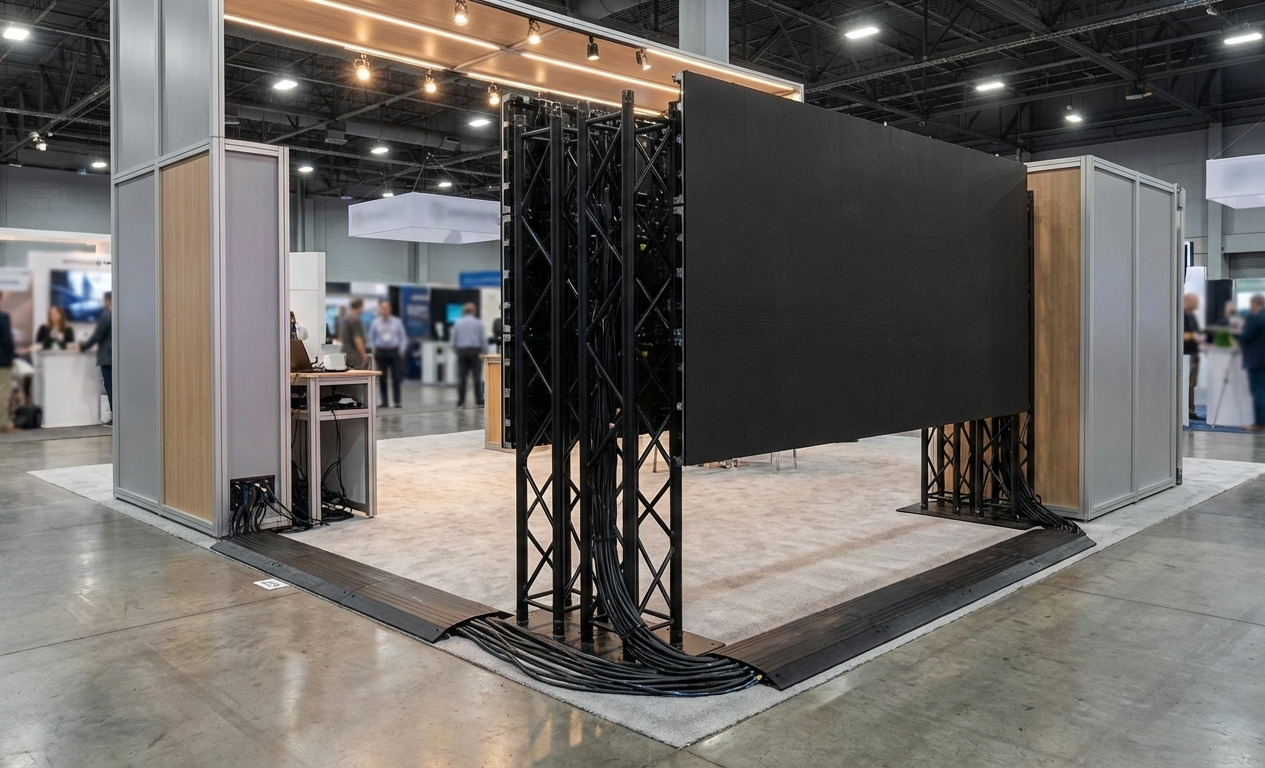
Choose Ground Support Over Rigging When Possible
Rigging (hanging equipment from ceilings) is one of the highest labor costs at major convention centers.
Switching to ground-supported structures:
Eliminates rigging labor
Cuts union costs
Speeds up installation
Reduces failure risk
Avoid Venue-Owned AV When You Have a Choice
In-house AV departments charge:
Higher equipment rates
Higher labor rates
Mandatory service fees
Independent AV providers like AVR Expos often deliver:
Newer gear
Lower pricing
Dedicated technicians
Better flexibility
Always compare quotes before signing a venue AV contract.
Consolidate AV Rentals With One Provider
Using multiple vendors increases:
Delivery fees
Drayage
Coordination time
Risk of incompatibility
A single AV partner can bundle:
LED walls
Monitors
Audio
Projectors
Touchscreens
Cables and accessories
This significantly reduces costs and simplifies communication.
FAQs
Q1: What is the biggest AV expense exhibitors underestimate?
Rigging and venue power — both cost far more onsite than expected.
Q2: Does reducing AV equipment harm booth engagement?
Not when done strategically. One well-placed display often outperforms several smaller ones.
Q3: Can AVR Expos help optimize my AV budget?
Yes — we design cost-efficient packages tailored to your booth goals.
https://www.avrexpos.com/wp-content/uploads/2025/12/Gemini_Generated_Image_ep7wbdep7wbdep7w.png7681408Nicholas Baadshaughttps://www.avrexpos.com/wp-content/uploads/2023/08/AVR-logo-1.webpNicholas Baadshaug2025-12-08 06:21:012025-12-14 06:22:25How to Reduce AV Costs at Trade Shows Without Sacrificing Quality
Chicago events — especially those at McCormick Place and downtown hotel ballrooms — demand clear, controlled audio. These venues are large, reflective, and unforgiving. Without the right strategy, you end up with hot spots, dead zones, echo, or feedback. A strong audio plan ensures exhibitors, presenters, and corporate teams deliver their message with precision.
This guide breaks down how to design a clean, consistent audio strategy for Chicago events.
Determine Coverage Requirements
Small booths need lightweight reinforcement.
Breakout rooms require even coverage.
Large sessions demand distributed audio.
Chicago’s concrete-heavy architecture requires wider audio dispersion to avoid reflections.
Speaker Selection for Chicago Venues
Best speaker types:
8-inch powered speakers for booth demos
10–12 inch speakers for breakout rooms
Line-array speakers for larger sessions
Use directional speakers for show floors to avoid bleed.
Microphone Selection
Handheld wireless: best for Q&A
Lavalier: ideal for presenters who walk
Headset: best clarity in noisy environments
Gooseneck: for panel tables
Chicago events often require frequency coordination to avoid interference.
Mixing Strategy
Use a digital mixer for:
Multi-input management
EQ shaping
Compression
Scene recall
Quick adjustments
Chicago rooms are reflective — cut low frequencies and avoid boosting high mids.
Distributed Audio for Large Rooms
For rooms larger than 60 feet:
Use 4–6 speakers spaced evenly
Avoid placing speakers too close to walls
Use delay speakers to maintain timing
McCormick Place often requires distributed audio because of ceiling height and room scale.
Cable Management in Chicago Venues
High foot traffic demands:
Secured cable runs
Black cable ramps
Velcro ties
Truss or booth-frame routing
Audio failures often come from cabling, not equipment.
Sound Checks and Live Monitoring
Before doors open:
Set EQ
Balance mics
Run video playback tests
Check every wireless channel
During the event:
Monitor levels
Adjust gain
Replace batteries
Correct feedback instantly
FAQs
Q1: What’s the most common audio issue in Chicago venues?
Reflections from concrete and glass surfaces that cause echo.
Q2: Do I need a mixer for small booth demos?
Yes. Even a small mixer helps manage gain and avoid feedback.
Q3: Does AVR Expos provide onsite techs in Chicago?
Absolutely — full delivery, setup, tuning, and strike.
https://www.avrexpos.com/wp-content/uploads/2025/12/Audio-Packages-in-Washington-DC-1.jpg6281200Nicholas Baadshaughttps://www.avrexpos.com/wp-content/uploads/2023/08/AVR-logo-1.webpNicholas Baadshaug2025-12-07 07:46:212025-12-07 07:46:42How to Build a Complete Audio Strategy for Chicago Trade Shows and Conferences
Washington DC is a hub for government briefings, policy summits, think-tank events, federal conferences, and high-level agency meetings. These events demand clarity, accuracy, and engagement. Traditional slide decks and printed materials simply don’t hold an audience’s attention anymore — especially when decision-makers expect fast access to data.
Touchscreens have rapidly become the go-to solution for interactive engagement at DC events. They’re precise, efficient, and ideal for secure environments where information needs to be delivered clearly and professionally.
Here’s why touchscreens are now standard in Washington DC’s government and policy event landscape.
Touchscreens Elevate Data Presentation
Policy events require data-heavy communication: charts, timelines, policy comparisons, dashboards, and model outputs.
Touchscreens improve this by enabling:
Interactive drilling into data
Visual demos of policy impacts
Tap-to-expand charts
Real-time annotation
Cleaner audience engagement
Instead of flipping slides, speakers can manipulate information live.
Touchscreens Improve Engagement in Think-Tank Settings
DC think-tank events rely on:
Research summaries
Case studies
Scenario modeling
Multi-path policy outcomes
Touchscreens allow attendees to explore these materials on their own terms.
Compliance-Friendly Hardware
Government venues often require:
Secure cable routing
Non-wireless content options
Encrypted playback sources
Touchscreens support:
Locked-down laptops
Hardwired HDMI
Local playback only
This makes them ideal for federal use.
Perfect for Breakout Sessions
Breakout rooms in DC events are where the real work happens.
Touchscreens support:
Small-group collaboration
Digital whiteboarding
Brainstorm capture
Interactive frameworks
Instead of sticky notes, everything becomes digitized instantly.
Touchscreens Reduce Printed Material Costs
Government and policy events often produce a mountain of printouts.
Touchscreens replace:
Folders
Reports
Policy briefs
Handouts
Everything becomes digital and searchable.
Best Touchscreen Sizes for DC Events
32–43 inch: kiosks and attendee browsing
55 inch: presenter-led content
65 inch: group collaboration
75 inch: plenary-level interactivity
Touchscreen Placement in DC Venues
Place touchscreens:
Near entrance zones
In breakout rooms
Along panel session corridors
Within advocacy or organizational booths
FAQs
Q1: Are touchscreens secure enough for federal events?
Yes. They support locked-down hardware and encrypted local playback.
Q2: Do DC venues allow kiosks and touchscreen stands?
Yes, as long as they follow standard fire-lane rules.
Q3: Can touchscreens run offline content?
Absolutely. Many government events require offline-only content.
https://www.avrexpos.com/wp-content/uploads/2025/12/Gemini_Generated_Image_c0y8erc0y8erc0y8-scaled.png14292560Nicholas Baadshaughttps://www.avrexpos.com/wp-content/uploads/2023/08/AVR-logo-1.webpNicholas Baadshaug2025-12-06 11:14:362026-01-07 13:52:38Why Touchscreens Are Becoming Essential for Government and Policy Events in Washington DC
Las Vegas hosts some of the highest-production exhibits in the world. Whether you’re at the Las Vegas Convention Center, the Venetian Expo, or Mandalay Bay, visual competition is fierce. This means your booth’s monitor configuration can’t be average — it needs to be deliberate, visible, and clean. The difference between a 10×10 booth that looks generic and one that commands aisle attention is almost always the AV layout.
Here’s how to optimize monitor configurations for 10×10 and 10×20 booths in Las Vegas without wasting space, blowing your budget, or compromising visibility.
Monitor Sizes for 10×10 Booths
Most exhibitors under-size their displays. For Las Vegas lighting and aisle distance, these are your targets:
55–65 inch monitors for primary displays
43 inch monitors for secondary or demo stations
32 inch touchscreens for lead capture
Avoid 75-inch screens in a 10×10 unless your booth has a minimalist layout.
Monitor Sizes for 10×20 Booths
10×20 booths let you layer screens strategically.
Recommended configurations:
Two 65-inch monitors on side walls
One 75–98 inch display as the primary forward-facing screen
A touchscreen kiosk near the aisle for engagement
This layout increases visibility from multiple angles — important in Las Vegas where traffic flows in wide aisles.
Use Vertical Orientation for Aisle Visibility
Vertical screens perform exceptionally well on the strip side of LVCC North and Central Hall because aisle visibility is stretched.
Vertical screens are ideal for:
Digital posters
Motion typography
Feature highlights
QR code captures
Horizontal screens are still best for:
Software demos
Product videos
Training content
Wall Mount vs. Stand Mount
Wall mounts look more premium and save floor space.
Stand mounts offer flexibility but require cable concealment.
In Las Vegas, wall mounting is preferred because it:
Reduces trip hazards
Keeps cables hidden
Survives heavy foot traffic
Looks cleaner in high-end booths
If you must use stands, use heavy bases with rear cable runs.
Use Multi-Monitor Zones to Control Flow
For 10×20 booths, build zones:
Zone A: Primary storytelling screen
Zone B: Demo monitors
Zone C: Touchscreen engagement
This layout keeps people moving without crowding your space.
Brightness Matters in Las Vegas
Choose commercial 4K monitors with 700–1,000 nit brightness.
Consumer TVs wash out in Vegas convention lighting.
Use HDMI Switchers or Matrix Routing
Las Vegas exhibitors often run:
Multiple laptops
Video loops
Presentation decks
Camera feeds
Use an HDMI matrix or switcher to avoid cable swapping.
Content Tips for Vegas Shows
High-contrast visuals perform best.
Motion graphics draw attention.
Use 20–30 second loops to maintain rhythm.
FAQs
Q1: Should I use one large monitor or multiple smaller ones?
If visibility is your goal, one large display in the center is strongest. For demos, multiple screens work better.
Q2: Do Vegas shows require special mounting rules?
Most allow wall mounts, but some shows restrict stand placement in high-traffic aisles.
Q3: Can AVR Expos deliver and install directly at LVCC or Mandalay Bay?
Yes. Delivery, setup, and strike are included.
https://www.avrexpos.com/wp-content/uploads/2025/12/Gemini_Generated_Image_97878a97878a9787-scaled.png13522560Nicholas Baadshaughttps://www.avrexpos.com/wp-content/uploads/2023/08/AVR-logo-1.webpNicholas Baadshaug2025-12-04 10:51:192025-12-06 10:51:42The Best Monitor Configurations for 10×10 and 10×20 Booths at Las Vegas Trade Shows
Orlando is one of the busiest trade show destinations in the country, home to massive events at the Orange County Convention Center and dozens of surrounding hotels and conference venues. Exhibitors spend tens of thousands of dollars on booth designs, printed graphics, and brand materials — only to replace everything again the following year. The cost adds up, the logistics get messy, and the visual impact rarely matches what you see in renderings.
LED walls have changed that. Instead of committing to static printed graphics that can’t be edited once they’re produced, Orlando exhibitors are moving to digital backdrops that can be refreshed instantly, animated, repurposed across multiple events, and built at nearly any size. If you’re looking to reduce printing costs, simplify your booth workflow, and modernize your presence, LED walls are your smartest long-term move.
Below is a clear breakdown of how LED walls can completely replace (and outperform) printed graphics for Orlando trade shows.
Replace Printed Graphics With Dynamic Digital Content
Printed graphics are frozen in time. Once they’re printed, that’s it — no edits, no animation, no reformatting. LED walls, however, turn your booth into a flexible digital canvas.
Advantages over printed graphics:
Animations and motion graphics catch attention from aisles
Real-time updates to messaging
Unlimited content variations
No shipping tubes, no carton damage, no reprints
Cleaner branding with perfect edge-to-edge visuals
Printed backwalls make your booth look static. LED walls make it look alive.
LED Pixel Pitch Options for Orlando Visibility
Orlando’s exhibit halls are wide open with long sight lines. Here’s the best pixel pitch guidance:
1.5 mm — premium, close-view applications
1.9 mm — ideal for 10×10 and 10×20 booths
2.6 mm — best all-around pitch for OCCC exhibit halls
3.9 mm — only for long-distance visibility or large stages
Most exhibitors moving from printed graphics choose 1.9 or 2.6 mm walls because the text and visuals match the clarity of a printed graphic — but with animation.
Choose the Best LED Wall Size to Replace Your Printed Backdrops
The most common printed backdrops in Orlando are 8’, 10’, 16’, and 20’ wide. LED walls can match any of them.
Popular sizes for booth backwalls:
8×12 ft — perfect for 10×20 booths
10×16 ft — replaces a full printed backwall
12×20 ft — stage-level impact
Custom dimensions — built tile by tile
If you’ve been using a printed SEG frame system, an LED wall can be built to the exact same footprint.
Use LED Walls to Reduce Year-Over-Year Costs
On paper, LED walls appear more expensive. But once you add printing, reprints, shipping, drayage, storage, and replacement fees, LED wins long-term.
Eliminate:
Crate fees
Forklift charges
Damaged print replacements
Multi-year redesign costs
Graphic reprints
Your content becomes digital, reusable, and editable — no more waste.
LED Walls Are Ideal for Orlando’s Bright Lighting
Orlando venues often run high-intensity lighting to accommodate photography and filming.
LED walls are:
Brighter
Clearer
More color-accurate
Less affected by glare
Printed graphics wash out under aggressive lighting. LED ignores it.
Content Strategy When Switching From Printed to Digital
Instead of sending huge print files, you send video or animated content.
Best-performing content types:
Animated brand loops
Product highlight reels
Testimonials
Motion typography
QR code transitions
Soft ambient color motion
You aren’t just replacing graphics — you’re upgrading the booth’s energy.
Installation Rules for Orlando Venues
The OCCC allows:
Ground-supported LED walls
Walls mounted to booth structures
Rigged LED walls (depending on show rules)
AVR Expos handles:
Delivery
Build
Calibration
Processor setup
Strike and removal
FAQs
Q1: Will an LED wall cost more than my printed walls?
Not long-term. Once you eliminate printing, reprints, shipping, and storage, LED becomes more cost-effective.
Q2: Can LED content match my brand colors?
Yes. LED walls use calibrated color profiles for accurate reproduction.
Q3: Can I reuse the same LED content at different shows?
Absolutely — you can repurpose or update it anytime.
https://www.avrexpos.com/wp-content/uploads/2025/12/Gemini_Generated_Image_4q59zg4q59zg4q59.png10241024Nicholas Baadshaughttps://www.avrexpos.com/wp-content/uploads/2023/08/AVR-logo-1.webpNicholas Baadshaug2025-12-02 05:26:232025-12-04 05:27:33How Orlando Exhibitors Can Use LED Walls to Replace Printed Graphics and Reduce Costs
We may request cookies to be set on your device. We use cookies to let us know when you visit our websites, how you interact with us, to enrich your user experience, and to customize your relationship with our website.
Click on the different category headings to find out more. You can also change some of your preferences. Note that blocking some types of cookies may impact your experience on our websites and the services we are able to offer.
Essential Website Cookies
These cookies are strictly necessary to provide you with services available through our website and to use some of its features.
Because these cookies are strictly necessary to deliver the website, refusing them will have impact how our site functions. You always can block or delete cookies by changing your browser settings and force blocking all cookies on this website. But this will always prompt you to accept/refuse cookies when revisiting our site.
We fully respect if you want to refuse cookies but to avoid asking you again and again kindly allow us to store a cookie for that. You are free to opt out any time or opt in for other cookies to get a better experience. If you refuse cookies we will remove all set cookies in our domain.
We provide you with a list of stored cookies on your computer in our domain so you can check what we stored. Due to security reasons we are not able to show or modify cookies from other domains. You can check these in your browser security settings.
Google Analytics Cookies
These cookies collect information that is used either in aggregate form to help us understand how our website is being used or how effective our marketing campaigns are, or to help us customize our website and application for you in order to enhance your experience.
If you do not want that we track your visit to our site you can disable tracking in your browser here:
Other external services
We also use different external services like Google Webfonts, Google Maps, and external Video providers. Since these providers may collect personal data like your IP address we allow you to block them here. Please be aware that this might heavily reduce the functionality and appearance of our site. Changes will take effect once you reload the page.
Google Webfont Settings:
Google Map Settings:
Google reCaptcha Settings:
Vimeo and Youtube video embeds:
Other cookies
The following cookies are also needed - You can choose if you want to allow them:
Privacy Policy
You can read about our cookies and privacy settings in detail on our Privacy Policy Page.