How to Choose the Right Monitor Size for Your Trade Show Booth

Choosing the right monitor size for your trade show booth seems straightforward until you start planning. Exhibitors often discover too late that their screen is too small to be seen from the aisle or too large and overpowering for their booth layout. Screen size affects how attendees interact with your booth, how your content displays, and ultimately how your brand is perceived on the show floor.

This guide breaks down exactly how to pick the right monitor size for any booth layout, whether it’s a 10×10, 10×20, or island configuration.

The Monitor Sizing Formula

A simple rule used by professional AV installers is:

Viewing distance ÷ 1.5 = minimum diagonal size.

Examples:

  • Viewers 6 feet away → 40–50-inch monitor minimum
  • Viewers 9 feet away → 65-inch monitor minimum
  • Viewers 12 feet away → 75–98-inch monitor ideal

Trade shows are busy, with visual clutter everywhere, so it’s usually better to err on the larger side.

Sizing Recommendations by Booth Type

10×10 Booth

  • One 55–65-inch screen as the main visual
  • Optional small touchscreen for lead capture or quick demos
  • Avoid 75-inch displays unless the booth is extremely minimalistic and you have the wall space to support it

10×20 Booth

  • Two 55–65-inch displays for dual-side engagement
  • Or one 75–98-inch large display as the focal point
  • This format is great for software demos, looping videos, and brand storytelling

Island Booth

Island booths offer more freedom and can support bolder AV choices.

Ideal sizes:

  • 65–98-inch screens on multiple sides
  • Ultra-wide formats for immersive visuals
  • Hanging displays or overhead screens if venue rules allow

Orientation Matters: Vertical vs. Horizontal

Vertical (Portrait) Screens

Vertical screens are ideal for:

  • Digital posters
  • Motion graphic branding
  • Product feature highlights
  • QR code callouts directing attendees to landing pages

Vertical content is highly effective at catching attention in crowded aisles because it behaves like a digital banner.

Horizontal (Landscape) Screens

Horizontal screens work best for:

  • Promotional videos
  • Software demos
  • Training or walkthrough content
  • Presentations or multi-input switching

Horizontal orientation is the safest default for most exhibitors because it aligns with how most content is produced.

When to Use Multiple Screens

Multiple monitors help control attendee flow and create separate experience zones within your booth.

Good use cases:

  • Left and right side aisles
  • Dedicated product or solution zones
  • Demo stations for independent browsing
  • Reception or check-in areas
  • Multi-person presentations or training sessions

If you’re using more than one screen, make sure your content strategy is consistent and intentional. Each display should serve a clear purpose.

Consider Brightness and Viewing Angle

In a trade show environment, ambient light is rarely ideal. Monitors need high brightness to compete with open hall lighting and other booths.

Target:

  • At least 700 nits of brightness for trade show environments

Avoid consumer TVs that wash out under strong overhead lighting. Commercial monitors are designed to stay visible and consistent for longer periods.

How Monitor Size Affects Content Design

Larger screens require content built for scale.

Content rules:

  • No text below 40 pt on 55–65-inch screens
  • No text below 60 pt on 75–98-inch screens
  • Use high-contrast color combinations
  • Avoid busy backgrounds behind key text

If your content is built for a small laptop screen and you simply scale it up, it often looks weak or hard to read from the aisle.

FAQs

Q1: Is a 98-inch display too big for a small booth?

Not if it’s wall-mounted and your layout is clean. The key is making sure it doesn’t block sightlines or reduce open space.

Q2: What’s better for demos: a monitor or a touchscreen?

Touchscreens win for engagement and interaction. Monitors win for pure visibility and distance viewing. Many exhibitors use both.

Q3: Can AVR Expos help determine screen placement?

Yes. We handle installation and help you position screens for maximum impact and visibility.
The Most Common AV Mistakes Exhibitors Make (and How to Avoid Them)

Trade shows are unforgiving environments. You have seconds, not minutes, to capture a moving attendee’s attention. Exhibitors invest thousands in travel, freight, booth design, and graphics, yet some of the most impactful decisions come down to the one area most teams overlook: AV strategy.

Screens mounted too low. Displays not bright enough. Pixel pitch that doesn’t match viewing distance. Audio that bleeds into the aisle. Content that looks stretched or blurry because it wasn’t formatted correctly. These are the mistakes that separate a polished, confident booth from the ones attendees walk past without stopping.

This guide breaks down the most common AV mistakes exhibitors make — and exactly how to avoid them — regardless of booth size, budget, or industry.

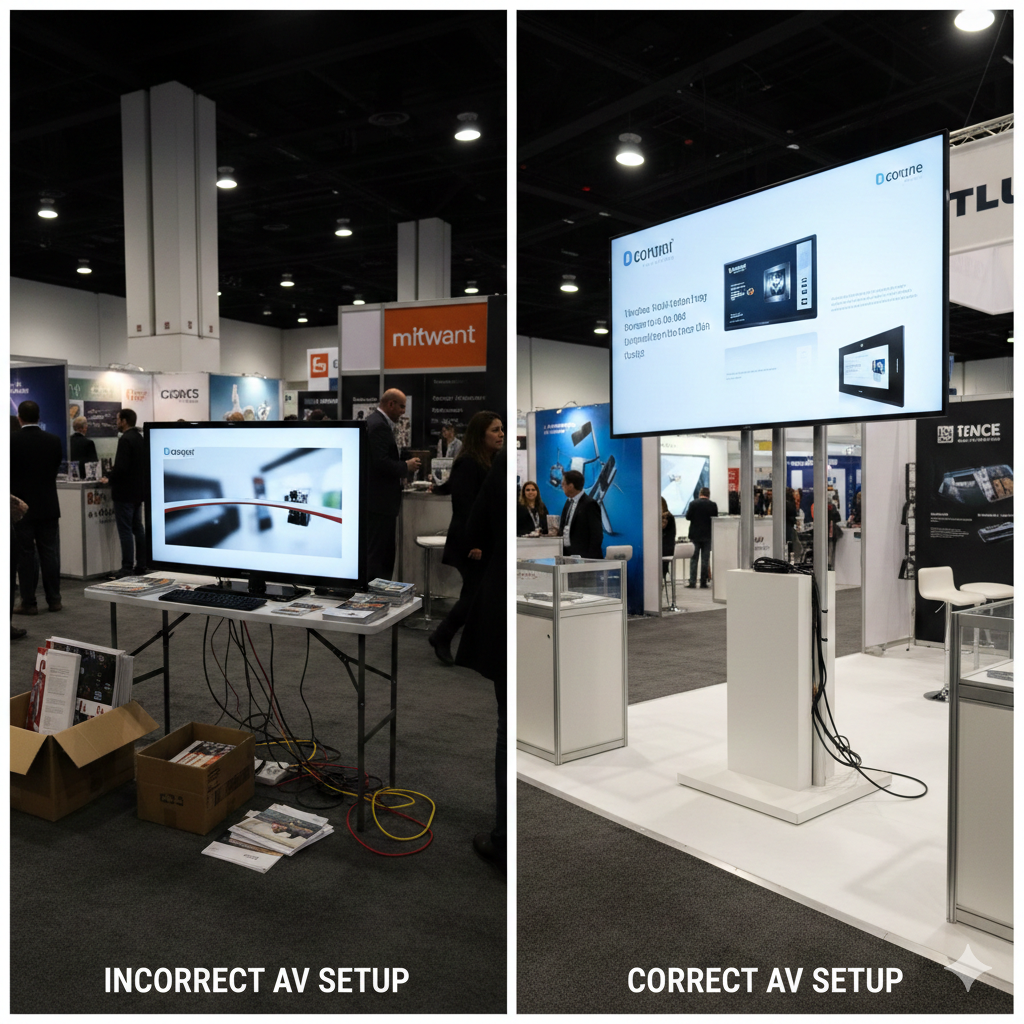
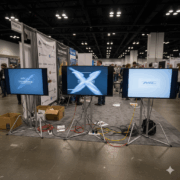
Split image comparing incorrect low-mounted screens on the left and properly elevated commercial displays on the right.

Mistake #1: Mounting Screens Too Low

Low-mounted screens are the silent killer of booth performance. When a display sits near eye level or lower, several problems show up immediately:

  • People walking by block the content
  • Your message disappears behind product tables or counters
  • Aisle visibility drops dramatically
  • Your booth feels visually cramped

The Fix: Mount Higher Than You Think

The center of your primary display should sit around 6 to 7 feet high, depending on venue restrictions. Tall mounting increases long-distance visibility and makes your booth feel larger and more premium.

Mistake #2: Using Consumer-Grade TVs Instead of Commercial Displays

A standard TV from a retail store is not built for trade shows.

Here’s why:

  • Lower brightness (typically 350–400 nits)
  • Shorter runtime limits
  • Bezels that look cheap under show lighting
  • Limited input and control options
  • Increased risk of failure under continuous use

The Fix: Rent Commercial-Grade or LED Displays

Commercial 4K monitors offer:

  • 700–1,000 nit brightness
  • Full-day operation without overheating
  • Slimmer bezels and more robust housings
  • More stable color calibration

LED walls go even further with seamless edges, modular construction, and high visibility from across the hall.

Mistake #3: Incorrect Content Resolution

If your content isn’t formatted for the display, your entire booth suffers.

Common issues include:

  • Stretched or distorted images
  • Black bars on the top or sides of the screen
  • Blurry or soft video playback
  • Pixelated or hard-to-read text

The Fix: Match Content to Exact Pixel Dimensions

If you’re displaying on:

  • 1080p monitors → design in 1920 × 1080
  • 4K monitors → design in 3840 × 2160
  • LED walls → design to the wall’s exact pixel count (for example, 1536 × 768)

LED content needs to be built intentionally. Guessing leads to poor visual quality.

Mistake #4: Choosing the Wrong Pixel Pitch

Pixel pitch determines clarity. Too large of a pitch and viewers will see the “screen door effect.” Too fine of a pitch and you overpay without any real benefit based on viewing distance.

The Fix: Match Pitch to Viewing Distance

As a general rule:

  • 1.5–1.9 mm: For close viewing (less than 6 feet)
  • 2.6 mm: Standard trade show pitch for most booths
  • 3.9 mm and above: Not recommended for indoor exhibit booths

Trade shows often call for 2.6 mm. Small booths or high-end product displays targeted at close viewing benefit from 1.9 mm.

Mistake #5: Poor Audio Planning

Audio problems are easy for attendees to notice and hard to fix once the show opens.

Common failures include:

  • Using speakers that are too loud for the space
  • Audio bleeding into neighboring booths
  • Using consumer Bluetooth speakers that drop out or distort
  • Microphone feedback
  • Inconsistent volume across zones or areas of the booth

The Fix: Choose Directional Audio and Proper Gain Structure

Professional AV teams balance:

  • Speaker placement
  • Volume levels
  • Audio direction
  • Feedback reduction
  • Microphone EQ and compression

The goal is controlled clarity, not blasting volume.

Mistake #6: Last-Minute Power Planning


Half of the issues exhibitors face stem from assuming that “power is power.” It isn’t.

The Risks of Underestimating Power:

  • LED walls shutting down under load
  • Monitors flickering or powering off
  • Equipment overheating
  • Poor cable placement creating hazards

The Fix: Order Enough Power

Most booths need approximately:

  • LED walls: 10–20 amps
  • Monitors: 1–2 amps each
  • Touchscreens: 2–3 amps
  • Audio gear: 3–5 amps

Always round up. Convention center late fees for additional power ordered onsite are painful.

Mistake #7: No Backup Content

If your primary playback device fails, the booth experience can collapse instantly.

The Fix: Always Bring Backup Media

You should have:

  • A USB backup with all media files
  • A secondary laptop or playback device
  • A backup HDMI cable
  • Offline versions of all key videos
  • Static image fallbacks for your screens

AVR Expos technicians always bring backups. You should too.

FAQs


Q1: What’s the most common AV mistake exhibitors make?

Low screens and mismatched content resolution.

Q2: Can AVR Expos review our content before the show?

Yes. We can test and verify your files before going onsite.

Q3: How can we avoid audio bleed into neighboring booths?

Use directional speakers, lower gain, and proper EQ to control spill.

The Complete AV Guide for Designing a High-Impact 10×20 Trade Show Booth

A 10×20 trade show booth gives you room to build something impressive, but it also forces every design decision to be intentional. When you add AV into the mix, the stakes rise quickly. LED walls, monitors, audio, cabling, mounts, content formatting, power requirements — each piece shapes how attendees see, hear, and remember your brand.


For first-time exhibitors or small marketing teams, this is where things often unravel. You walk onto the show floor, plug in your screens, and suddenly nothing fits the way you expected. Screens are too low. Content doesn’t scale correctly. Speakers are too loud for the aisle. And your booth that looked great on a PDF layout suddenly feels flat.


This guide cuts through the noise. Whether you’re preparing for a show in Las Vegas, Dallas, Orlando, Chicago, New Orleans, or any other major market AVR Expos services, this is the blueprint to plan a clean, high-impact AV setup for a 10×20 space.


Begin With the Visual Anchor: Your Primary Screen


Every 10×20 booth needs one clear focal point. For most exhibitors, it’s the main display.

That could be:

  • A 98-inch commercial 4K monitor
  • A mid-size LED wall (for example, 8’ × 12’)
  • A set of two 55–65-inch monitors mirrored on each side
  • A touchscreen kiosk acting as both a display and interaction point

The goal isn’t to fill the space. The goal is to control where the eye goes.

LED or LCD? Pick Based on Experience, Not Trend


Choose LED when:

  • You want a seamless digital backdrop
  • You need high brightness to stand out
  • Your content is motion-heavy or stylized
  • You want your booth to look modern, clean, and premium


Choose LCD when:

  • You prefer multiple smaller screens for different zones
  • You want touch capability
  • You’re doing software demos or interactive content

LED walls dominate visually, but LCD monitors deliver clarity and consistency for applications that need precision.


Screen Height and Placement: The Sightline Rule

Screen height is one of the top AV mistakes exhibitors get wrong.


The center of your primary display should be:

  • At least 6 feet high
  • Angled slightly toward aisle traffic
  • Positioned so attendees walking by can see it unobstructed


If you mount it too low:

  • People block the view
  • It loses visibility from the aisle
  • The booth feels cluttered


Your main screen is your billboard. Treat it like one.

Multi-Screen Configurations for a 10×20 Space


A 10×20 booth can support multiple screens without looking chaotic if you plan correctly.

Layout 1: “Command Center” Setup

  • One large LED wall as the anchor
  • Two side monitors for supplemental content
  • One touchscreen kiosk for demos

This layout is ideal for companies with complex products or multi-step presentations.

Layout 2: “Dual Engagement” Setup

  • Two 65-inch monitors on each short wall
  • One reception counter with hidden cabling
  • No LED wall, but strong content flow

This format drives interaction from both sides of the booth.

Layout 3: “Digital Backdrop” Setup

  • One LED wall (8’ × 12’ or similar)
  • Minimal furniture
  • A single touchscreen up front for lead capture

It’s clean, modern, and highly visible from the aisle.

Audio Strategy: Clear, Direct, and Controlled

Audio can easily overwhelm a 10×20 booth. You’re sharing space with dozens of exhibitors, and every booth is fighting for attention.

What not to use:

  • Subwoofers that shake nearby booths
  • Full PA systems that are too loud and overpowering
  • Cheap Bluetooth speakers that are inconsistent and unreliable

What works best:

  • Two 8-inch powered speakers
  • Minimal volume — just enough for your zone
  • A wireless handheld mic for demos or small presentations
  • Directional audio that aims toward the interior of your booth

Your goal is clarity, not volume.

Cable Management: The Hidden Part Everyone Notices

Messy cabling kills booth presentation. Great AV is invisible until it fails.


AVR Expos technicians typically:

  • Run power beneath the raised floor or along truss lines
  • Hide cabling behind the LED wall or back side blocking
  • Use black cable sleeves to blend with flooring
  • Anchor everything to avoid tripping hazards

When done correctly, attendees should never see your wires, connections, or processors.

Content Strategy: The Most Overlooked Part of AV Planning


Your AV is only as good as the content running on it.

Content formatting essentials:

  • Match LED content to exact pixel dimensions
  • Don’t stretch 1080p content to fill a 4K display
  • Keep text large enough to read from 10–20 feet away
  • Use looping videos no longer than 20–30 seconds

Content types that work best:

  • Animated product demos
  • Motion graphics that pull attention
  • Testimonials or partner spotlights
  • Feature highlights with bold typography
  • QR codes that drive deeper engagement

Your content shouldn’t just communicate. It should attract.

Power Requirements: Avoid Last-Minute Surprises

A 10×20 booth typically needs anywhere from 10 to 30 amps, depending on your AV load-out.

Typical requirements:

  • LED wall: 10–20 amps depending on pitch and brightness
  • Monitors: 1–2 amps each
  • Speakers and audio gear: 3–5 amps
  • Touchscreens: 2–3 amps
  • Lighting: 1–3 amps per fixture

Order more power than you think you’ll need. Convention centers charge premium “add-on” rates onsite.

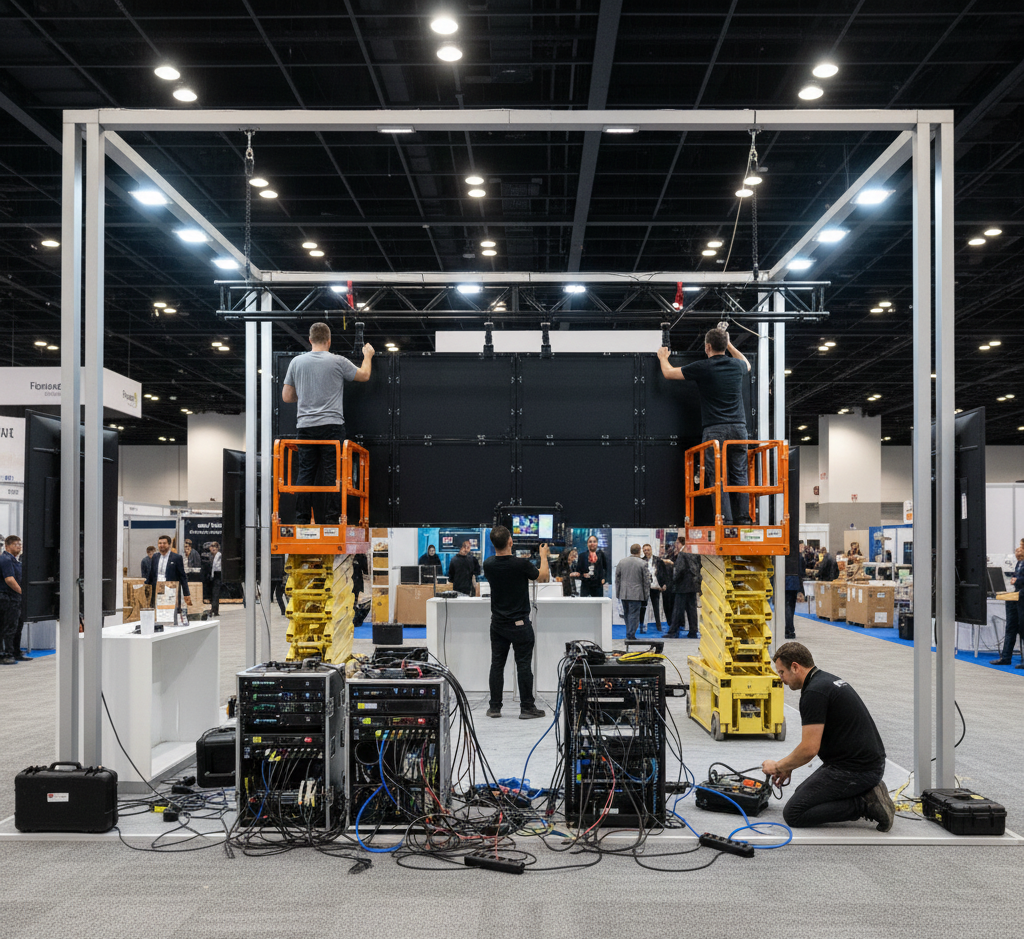
Technician calibrating LED wall brightness and color balance on a show floor.

Setup Timing: How Long Does It Really Take?


For a standard 10×20 booth, plan on:

  • LED wall setup: 2–4 hours
  • Monitor installation: 1–2 hours
  • Audio setup: 30–60 minutes
  • Testing and calibration: 1 hour

If your booth opens at 10:00 a.m., plan to be set by 8:00 a.m.

If your show opens Monday, install on Sunday.


FAQs


Q1: Can I use both LED and monitors in the same booth?

Absolutely. Many of the most successful 10×20 booths combine technologies for layered engagement.


Q2: Does AVR Expos provide setup and strike?

Yes. We handle full delivery, installation, calibration, and teardown.


Q3: What’s the best screen size for a 10×20?

Either an 8’ × 12’ LED wall or a 75–98-inch 4K monitor, depending on your content goals.


Audio Packages in Washington DC: Clear Sound for Powerful Events

In Washington DC, clarity isn’t optional — it’s expected. Whether you’re leading a high-level policy discussion, presenting to executives, or hosting a multi-room conference, your audio must be crisp, balanced, and reliable. AVR Expos provides professional audio equipment rentals across Washington DC with scalable options tailored to your venue, audience, and content.

From panel discussions to full-scale general sessions, we design sound systems that ensure every voice carries cleanly and every attendee hears exactly what they’re supposed to.

Choosing the Right Speaker System

Small Rooms (10–60 people)

Compact powered speakers such as 8” or 10” models. Perfect for breakout rooms.

Medium Rooms (60–250 people)

12” powered speakers or small array systems for balanced coverage.

Large Ballrooms

Full line arrays + subwoofers for high-quality sound without distortion.

Microphone Options for DC Events

Wireless Handhelds

Great for presenters who move around the stage.

Wireless Lavaliers

Ideal for panels or keynote speakers.

Push-to-Talk Conference Mics

Perfect for policy discussions or boardroom sessions requiring clarity and structure.

Why Professional Tuning Matters in DC

Washington DC venues often feature:

  • High ceilings
  • Reflective surfaces
  • Mixed seating layouts
  • Tight presentation schedules

We handle EQ, gain structure, multi-zone coverage, and handheld/lavalier balancing so your message lands clearly.

FAQs

Q1: Do you offer on-site audio technicians?

Yes. Every event includes setup, soundcheck, and monitoring.

Q2: Can I combine audio with LED and projection?

Absolutely — we design integrated AV packages.

Q3: How early should I reserve audio gear for DC events?

2–3 weeks in advance is ideal, especially for large conferences.

Projector Rentals in New Orleans: Illuminate Your Event with Professional AV Solutions

New Orleans hosts some of the most diverse and energetic event environments in the country — from corporate meetings in the French Quarter to large-scale conferences at the Ernest N. Morial Convention Center. Regardless of the setting, your visuals must be crisp, bright, and professionally presented. That’s where projector rentals from AVR Expos come in.


We provide high-lumen projectors and screens tailored to New Orleans’ unique lighting conditions and event layouts. Whether your content includes presentations, video, data visualizations, or sponsor loops, your projection needs to be reliable and visually sharp.

Understanding Lumen Requirements


7,000–10,000 Lumens

Ideal for mid-sized hotel meeting rooms or sessions with controlled lighting.

12,000–14,000 Lumens

Perfect for ballrooms and corporate general sessions with partial ambient light.

20,000+ Lumens

When you need bold visuals in large or brightly-lit venues.

Choosing the Right Screen Size


120”–150” Screens

Great for small to medium sessions up to 80 attendees.

16 ft × 9 ft Screens

Ballroom standard for larger corporate events.

Ultra-Wide Screens

Ideal for creative stage design or multi-presenter sessions.

Rear Projection vs. Front Projection


Rear Projection

Keeps gear hidden behind the screen. Clean aesthetic for keynote stages.

Front Projection

Better for tighter rooms where space is limited.

Why Projectors Are Still Essential in New Orleans Events


Even with LED walls gaining popularity, projectors remain a go-to for:

  • Galas
  • Breakout sessions
  • Training programs
  • Sponsor visibility loops
  • Hybrid events


They’re cost-effective, reliable, and versatile.

FAQs


Q1: Do projectors work well in rooms with ambient light?

Yes, with high-lumen models (10K–14K+) and proper screen selection.

Q2: Do you provide both screen and projector?

Yes, AVR Expos provides full projection packages.

Q3: Can I run multiple laptops into one projector?

Yes, we provide switchers for seamless presentation control.

Touchscreen Rentals in Atlanta: Turn Trade Show Traffic into Qualified Leads

The Atlanta trade show market is packed, fast-moving, and fiercely competitive. Exhibitors aren’t just chasing foot traffic at events like the Georgia World Congress Center or Cobb Galleria — they’re chasing interaction. Touchscreens bridge that gap. They transform passive visitors into active participants, letting your audience explore content, submit leads, customize products, or experience demos firsthand.


AVR Expos supplies touchscreen rentals throughout Atlanta, helping brands create experiences that feel intentional, modern, and measurable. If your goal is to capture higher-quality leads and build a booth experience attendees remember, touchscreens are one of the smartest tools you can add.

Why Touchscreens Work So Well for Atlanta Exhibitors


Engagement That Goes Beyond Passive Viewing

Modern attendees expect to interact with brands the same way they interact with their phones. Touchscreens match that expectation. They let people control the experience — browse catalog pages, view videos, swipe through product features, or complete surveys.

This shift from passive to active dramatically boosts:

  • Dwell time
  • Lead quality
  • Memorability
  • Sales funnel entry


Instant Lead Capture You Can Use Immediately

Our touchscreen kiosks can be preloaded with:

  • Lead forms
  • Email capture forms
  • QR code integration
  • CRM-connected landing pages

Every submission during the show becomes a qualified lead your sales team can act on right away.

Choosing the Right Touchscreen Size for Your Booth


43” Touchscreens

Ideal for tight booth layouts in 10×10 or 10×20 spaces. Great for single-user browsing or lead capture.

55”–65” Touchscreens

Perfect for booths with multiple demo stations or when you want the screen to double as a digital billboard between interactions.

Dual-Screen or Multi-Screen Walls

For more immersive booths, we can mount multiple displays side-by-side, allowing simultaneous engagement from multiple attendees.

Mounting Options That Fit Any Atlanta Booth Layout


Freestanding Kiosks

Great for island booths or open-floor concepts. Easy to position and cable-manage.

Wall-Mount Displays

Perfect for back walls, creating a clean look with zero footprint intrusion.

Tabletop Touchscreens

Good for product configuration demos, B2B presentations, or smaller meeting pods.

How Touchscreens Fit Atlanta’s Event Culture


Atlanta’s event scene runs on innovation and energy. Touchscreens align perfectly with the way attendees expect to engage. Whether you’re at:

  • Georgia World Congress Center
  • Cobb Galleria
  • Atlanta Marriott Marquis
  • Omni Atlanta Hotel


Touchscreens give your booth a modern, interactive feel that stands out from static competitors.

Content Strategies That Work Best on Touchscreens


Product Selectors and Configurators

Great for tech, manufacturing, or medical exhibits.

Interactive Catalogs

Attendees browse what interests them at their own pace.

Demo Videos with Tap Navigation

Break complex concepts into short, digestible clips.

 Gamified Experiences

Spin-to-win, trivia, and digital scavenger hunts drive long booth lines.


FAQs


Q1: Can AVR Expos preload my content onto the touchscreens?

Yes, we test and preload all apps, assets, and demos before delivery.


Q2: Do I need Wi-Fi for touchscreen use?

Not always. Touchscreens run perfectly offline using preloaded content.


Q3: Are touchscreens durable enough for high-traffic shows?

Absolutely — our commercial-grade panels are built for continuous use.

The Complete Guide to Choosing the Right LED Wall Size for Your Dallas Event

In Dallas, events move fast — and expectations move even faster. Whether you’re exhibiting at the Kay Bailey Hutchison Convention Center, hosting a corporate meeting in Uptown, or producing a large-scale activation in Deep Ellum, one thing is constant: your visuals have to deliver.


LED video walls are the standard for high-impact content delivery. But choosing the right size for your event is where most marketing teams and planners get stuck. Too small, and your content gets lost. Too large, and you waste budget or overwhelm the space.


This guide breaks down exactly how to choose the perfect LED wall size for any Dallas event using real-world formulas, venue insights, and technical considerations used by AVR Expos technicians every day.

Start with Viewing Distance (The Most Important Factor)


The Rule of 10


A quick sizing rule that works for most indoor Dallas venues:

Every 10 feet of viewing distance requires at least 1 foot of LED screen height.

Example:

If your furthest audience member is 50 feet away, you need at least a 5 ft tall LED wall.

Trade Show Example

In 10×20 Dallas booths, attendees stand 3–15 ft away.

That makes 8–10 ft wide and 6–7 ft tall walls ideal (common 16:9 or 3:2 layouts).


Conference Example


For breakout rooms or ballrooms with 20–60 ft viewing distances, a 16 ft × 9 ft LED wall becomes the standard.

Choose the Right Aspect Ratio


Standard Formats (for Presentations, Video, or Demos)

  • 16:9 – Most common. Works for slides, video, and general sessions.
  • 21:9 – Gaining popularity for wide-format immersive content.
  • 1:1 or 9:16 vertical – Great for digital posters or creative booth applications.


Custom Ratios for Booths


In Dallas trade shows, exhibitors often use:

  • 10’ × 10’ squared LED back walls
  • Vertical LED towers
  • Ultra-wide LED ribbons


We build these with modular 500mm tiles to match your exact booth dimensions.

Pixel Pitch Determines Minimum Viewing Distance


Pixel pitch = distance between LED diodes. Smaller pitch = sharper image.


Common Indoor Pitches for Dallas Events

  • 1.5mm – For luxury brands, automotive displays, close-up demos.
  • 1.9mm – Great for meetings and trade show booths.
  • 2.6mm – The most popular choice — perfect balance of clarity + budget.


How Pixel Pitch Affects Size


Lower pixel pitch = you can use a smaller screen without losing clarity.

Higher pitch = you need a bigger screen to maintain visual sharpness.

Venue Size and Lighting Conditions Impact Screen Size


Trade Show Booths


Dallas show floors are bright and competitive. LED walls must compete visually with:

  • Open ceilings with bright hall lighting
  • Tall neighboring booth structures
  • Busy aisles


Small booths need wall-filling backdrops to stand out — typically 8–12 ft wide.


Ballrooms and Meeting Rooms


Rooms with adjustable lighting give you more freedom. Larger walls (16–24 ft wide) work well here for:

  • General sessions
  • Presentations
  • Multi-speaker panels


Outdoor Events


Dallas outdoor venues require:

  • Higher brightness
  • Slightly larger LED surfaces for visibility
  • Weather considerations


A minimum 12 ft width is recommended for outdoor viewing.

Match LED Size to Content Type


Text-Heavy Presentations


Slides need height.

Rule of thumb:

LED height (in ft) should be 1/6 of the room length.


Video-Heavy Content


Use width.

Wider screens showcase motion graphics and cinematic content better.


Hybrid Events

Consider multi-zone layouts:

  • Center LED for main content
  • Side LED pillars for speaker support, branding, or remote guests

Real-World Examples from Dallas Installs


Example 1: 10×20 Trade Show Booth


Recommended:

8 ft × 12 ft LED wall (2.6mm)

Result: Engaging booth backdrop with clear content from up-close attendees.


Example 2: Ballroom General Session


Recommended:

16 ft × 9 ft LED wall (1.9mm)

Result: Crisp text and powerful visuals across a 150-person audience.


Example 3: Outdoor Corporate Activation


Recommended:

20 ft × 10 ft LED wall (2.6mm, high-brightness)

Result: High visibility even under Texas sunlight.

FAQs


Q1: What’s the most common LED wall size for Dallas trade shows?

A: 8×12 ft and 10×16 ft walls are the most requested for standard booth layouts.


Q2: How do I know if I need 2.6mm or 1.9mm pixel pitch?

A: If attendees view the screen from closer than 6 feet, choose 1.9mm. Otherwise, 2.6mm is ideal.


Q3: Can AVR Expos help design the wall layout?

A: Yes. We design, deliver, install, process, and support LED walls across Dallas venues.


Q4: Do I need a processor?

A: Yes. We provide Novastar processors (VX6s, VX1000, VX2000) for scaling, redundancy, and multi-input switching.

Interactive Touchscreen Displays: The Future of Event Engagement

In a world full of distractions, interactivity wins. Touchscreens transform passive attendees into active participants. Whether you’re running a digital catalog, a product demo, or an interactive map, touchscreen displays turn your booth into an experience—not just an exhibit.

Why Touchscreens Work


Engagement through control

When attendees touch, tap, and explore, they engage longer. That leads to better retention and stronger brand recall.

Data capture and analytics

Custom interfaces let you collect leads and track engagement metrics. Every tap tells you what your audience cares about most.

Touchscreen Options for Events


Freestanding kiosks

Perfect for product menus, surveys, and interactive demos. Available in 43” and 55” models.

Wall-mounted and tabletop

Wall mounts save space, while tables encourage collaboration. Both can run offline for reliability.

Multi-touch capability

Our touchscreens support up to 10-point touch with low latency for smooth performance.

Connectivity and Content Management


Plug-and-play setup

All rentals include HDMI, USB-C, and power cabling. Just connect your laptop or media player—no drivers needed.

Preloaded content

We preload your files and test functionality before delivery.

Offline reliability

Wi-Fi optional. All kiosks can run self-contained apps locally.


Internal Links

FAQs


Q1: Can you preload our app?

A1: Yes. We preload and test your app or content before delivery.


Q2: Are they compatible with Macs and PCs?

A2: Yes, they connect easily via HDMI or USB-C.


Q3: Do I need Wi-Fi?

A3: Not necessarily. All systems can operate offline.

The Complete Guide to Audio Systems for Corporate Events

Audio is the backbone of communication at any event. It’s the invisible thread connecting presenters to audiences. Whether you’re hosting a breakout session or a general session for 500 guests, the clarity and consistency of your sound define how your event feels.

Here’s how to build a system that sounds professional and performs reliably, every time.

Start with the Room and Audience Size

Small rooms (under 100 people)

Use two powered speakers, a small mixer, and wireless handheld or lavalier mics for maximum flexibility.

Medium rooms (100–400 people)

Deploy distributed 12–15” speakers or compact line arrays. This prevents audio “hot spots” and uneven coverage.

Large sessions or ballrooms

Add subwoofers for low-end warmth and delay fills for rear coverage. AVR Expos engineers design systems that keep speech intelligible in large rooms.

Choosing Microphones


Wireless vs. wired

Wireless offers freedom and speed; wired is fail-proof. We stock Shure and Sennheiser systems with proper frequency coordination to avoid interference.

Lavalier, handheld, or headset

Lavs are great for presenters, handhelds for audience Q&A, and headsets for speakers who move dynamically.

Mixers and Signal Flow


Digital mixers

QSC TouchMix and Allen & Heath QU series mixers allow pre-saved EQ curves and fast recall. They’re compact, reliable, and optimized for corporate AV setups.

Playback and integration

We route laptops, video playback devices, and phones through DI boxes for clean, balanced signal flow into the system.

Redundancy and Power Management

Fail-safe design

We use labeled signal paths, redundant wireless receivers, and UPS backup systems to ensure stability.

On-site support

Every major event includes a dedicated AVR Expos technician to monitor audio quality throughout.

Internal Links

FAQs


Q1: What size PA do I need?

A1: It depends on your audience size, ceiling height, and room acoustics. We’ll spec the exact coverage you need.


Q2: Can you record the event?

A2: Yes, we can record the main mix or provide press feeds for media coverage.


Q3: Do you include an audio engineer?

A3: Yes, most rentals include an engineer for setup, soundcheck, and live operation.

How to Choose the Right LED Video Wall for Your Trade Show Booth

Your booth’s LED video wall isn’t just a screen—it’s your brand’s main attraction. It captures attention, drives engagement, and gives your visuals the scale they deserve. But choosing the right one requires more than guessing at size and resolution. You’ll need to factor in pixel pitch, layout, brightness, and even mounting logistics to ensure your display looks sharp from every angle.


Here’s how to make a confident, technically sound choice for your next trade show.

Start with Viewing Distance and Pixel Pitch

Understanding pixel pitch

Pixel pitch measures the distance between LED clusters. The smaller the pitch, the sharper the image at close range. For most trade show booths:

  • 5mm–1.9mm is ideal for high-detail, close-up visuals.
  • 6mm is the sweet spot for typical 10×20 or 20×20 booths.
  • 9mm+ is best for large-scale or outdoor displays.


Avoiding the “overkill” mistake

Many exhibitors assume smaller pitch equals better quality—but it’s not always necessary. For most audiences standing 6–15 feet away, a 2.6mm wall offers crisp resolution without overpaying for ultra-fine tiles.


How AVR Expos tailors recommendations

Our team evaluates booth dimensions, sightlines, and lighting conditions before suggesting a configuration. Whether it’s INFiLED 2.6mm tiles for indoor booths or Unilumin 3.9mm for outdoor activations, we match technology to your real-world needs.


Mounting and Structural Considerations


Ground-supported vs. flown

Ground-supported walls save time and avoid rigging fees, while flown setups create eye-level visibility for large booths. AVR Expos designs both, ensuring compliance with venue regulations and weight limits.

Integration with exhibit structure

We coordinate directly with your exhibit fabricator to guarantee clean lines, balanced weight, and concealed cable paths. It’s what keeps your LED wall looking built-in, not bolted-on.


Processors and Playback Equipment


Why processors matter

We use Novastar processors (VX6s, VX1000, VX2000) for smooth scaling and redundancy. They handle multi-input content and ensure no single point of failure.

Playback and content switching

From PowerPoint decks to looping videos, AVR Expos pairs processors with ATEM Mini switchers, playback laptops, and fail-safe routing so transitions stay seamless on show day.


Optimizing for Ambient Lighting


Brightness calibration

Trade show lighting can easily wash out low-brightness walls. We calibrate brightness from 800 to 1,200 nits for indoor environments and up to 4,000 for outdoor setups.

Color uniformity

All walls are color-balanced using factory-calibrated profiles to ensure consistent tone across every tile.

Internal Links

FAQs


Q1: How do I determine the right pixel pitch?

A1: Measure your average viewing distance in feet and divide by 10. For example, 20 feet = 2.0mm pitch.


Q2: Can AVR Expos handle delivery and setup?

A2: Yes. We manage delivery, assembly, calibration, and teardown nationwide.


Q3: How long does setup take?

A3: A 16×9 LED wall usually installs in about 4 hours, depending on site logistics.

Inquiry Cart0
There are no products in the cart!
0
Get A Quote
Call Us
Get a Quote